
Wildlife
Animals
What types of plants and animals call the Dee Estuary home?
Below is a list of species you may see in and around the Dee Estuary.
If you would like to know more about any of the species there are links to helpful websites with the lists.
The Our Dee Estuary project has 3 focal species:
There is additional information on these species below. If you would like to know more about the work of the project, then please get in touch with us.
Mammals
- Atlantic grey seal Halichoerus grypus
- Common seal Phoca vitulina
- Harbour Porpoise – Phocoena phocoena
Seals
Grey seal

Chris Gomersall/2020VISION
Common seal
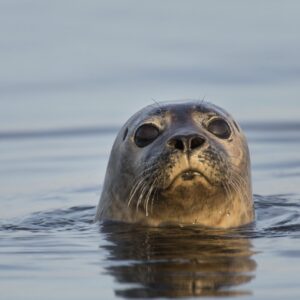
Alexander Mustard/2020VISION
When looking out at the wide expanse of mudflat it is hard to imagine mammals such as dolphins, porpoises, and seals swimming around in the estuary however during high tide the water brings with it an array of wildlife. It might be a surprise to know that all these species use the Dee Estuary.
Atlantic grey seal Halichoerus grypus
Common seal Phoca vitulina
Notice any differences between these two seals?
One is a grey seal and the other is a common seal and one of the ways you can tell them apart is their nose shape. Grey seals have parallel nostrils and common seals have V shaped nostrils. Furthermore, grey seals are bigger than common seals and finally, contrary to their name, there are more grey seals than common seals in British waters.
The best place to see seals on the Dee Estuary is Hilbre Island off West Kirby.
Harbour porpoise
As the name suggests this small stocky cetacean prefers to stay close to the shore which means that at high tide at the mouth of the estuary you may see them as they move up and down the Irish Sea between feeding grounds.
To find out more about the Harbour porpoise and why it got the nickname ‘Puffing Pig’ visit the Whale and Dolphin Conservation website.
To find out more about these species you can visit The Wildlife Trust website and search the species name there.
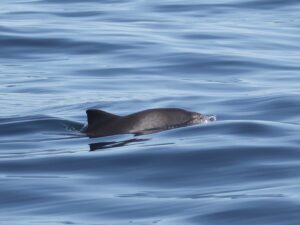
Niki Clear – Wildnet
Birds
There are some globally significant populations of birds that use the Dee Estuary either as summer breeding ground or to overwinter and fatten up for the year ahead.
In winter the populations of waders and waterfowl can exceed 120,000 birds.
If you would like to know more about the birds on the estuary the following website are a great place to start:
Bird species you may see on the Dee Estuary:
- Gulls and Terns
- Herons, storks, and ibises
- Sandpipers, snipes and phalaropes
- Avocets and stilts
- Wildfowl
- Waders
- Plovers
- Buntings
- Larks
- Finches
- Falcons
- Kites, hawks and eagles
Gulls and Terns
Little tern

Adam Jones – WildNet
The migratory Little tern is an important species for the Dee Estuary and a focal species for the Our Dee Estuary project.
There are two sites on the Dee Estuary where these threatened birds choose to breed. Gronant Beach in Denbighshire, Wales and Point of Ayr in Flintshire, Wales.
Protection for the breeding colony of Little terns at Gronant Beach is maintained by Denbighshire County Council with support from the voluntary North Wales Little Tern group.
At Point of Ayr decades of protecting the shingle for breeding ringed plovers and oystercatchers by the RSPB Dee Estuary resulted in the recolonisation by Little Terns in 2015 after over three decades absence from the site.
Common tern
The breeding population of Common terns have chosen a unique site on the Dee Estuary, the Tata Steel works in Shotton, Flintshire. There is a lake on the site that contains pontoons where both Common terns and Black headed gulls come to breed each year. The Nature Reserve at Tata Steel is jointly maintained by dedicated Tata Steel employees and volunteers from the Merseyside Ringing Group.

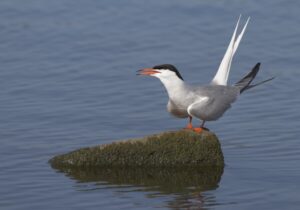
Richard Steel/2020VISION
Birds species you may see on the Dee Estuary
Gulls and Terns
- Little tern Sternula albifrons
- Common tern Sterna hirundo
Herons, storks, and ibises
- Bittern Botaurus stellaris
- Little egret Egretta garzetta
- Cattle egret Bubulcus ibis
- Great white egret Ardea alba
Sandpipers, snipes and phalaropes
- Snipe Gallinago gallinago
- Redshank Tringa tetanus
- Spotted redshank Tringa erythropus
- Eurasian curlew Numenius arquata
- Black tailed godwit Limosa limosa limosa
- Knot Calidris canutus
Avocets and stilts
- Avocet Recurvirostra avosetta
Wildfowl
- Wigeon Anas penelope
- Teal Anas crecca
- Shelduck Tadorna tadorna
Waders
- Oystercatcher Haematopus ostralegus
Plovers
- Lapwing Vanellus vanellus
- Ringed plover Charadrius hiaticula
Buntings
- Reed bunting Emberiza schoeniclus
Larks
- Skylark Alauda arvensis
Finches
- Linnet Carduelis cannabina
Falcons
- Peregrine falcon Falco peregrinus
- Kestrel Falco tinnunculus
Kites, hawks and eagles
- Marsh harrier Circus aeruginosus
- Buzzard Buteo buteo
Fish
- European eel Anguilla anguilla
- River lamprey Lampetra fluviatilis
- Sea lamprey Petromyzon marinus
- Brown trout/Sea trout Salmo trutta
- Atlantic salmon Salmo salar
Shellfish
- Common cockle Cerastoderma edule
- Lagoon cockle Cerastoderma glaucum
- Razor clam Ensis magnus
Common cockle
The Common cockle lives on muddy and sandy shores, between the high tide and low tide mark, and is commonly found in estuaries. It has a medium-sized clam-like shell, rounded and domed with radiating ridges. It feeds by filtering plankton and other organic matter from the water using its siphons. Cockles are an important food source for shorebirds such as oystercatchers, the shore crab, and flatfish.
Staff from the Our Dee Estuary project have been out with the team from Cyfoeth Naturiol Cymru | Natural Resources Wales to see what happens during a cockle survey. Watch the video below:
Insert cockle video.
Fun Fact!
Cockles can use their foot to jump across the surface of the mud if they accidentally get excavated!

Razor clam
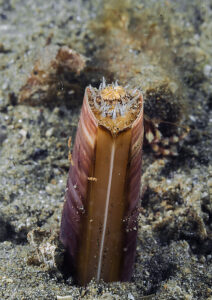
Mark Thomas – WildNet
Razor clams or razor shells are very recognisable, with their long, narrow clam shells. They are a burrowing species and live buried in the sand around the low tide mark and on the seabed out to around 60m deep. They dig themselves into the sand using their strong muscular “foot”. Razor clams filter feed on plankton and detritus and quite often, the 2 small siphons are all that is visible. After storms, huge numbers of razor clam shells often wash up on beaches. These shells will eventually break down and become sand.
Fun Fact!
In Scotland razor clams are called spoots – named after the jet of water they shoot out when burrowing at low tide.
Amphibians and Reptiles
- Natterjack toad Epidalea calamita (formerly Bufo calamita)
- Common toad Bufo bufo
- Common frog Rana temporaria
- Smooth newt Lissotriton vulgaris – formerly Triturus vulgaris
- Great crested newt Triturus cristatus
- Sand lizard Lacerta agilis
- Common lizard Zootoca vivipara – formerly Lacerta vivipara
Natterjack toad
One of 5 native amphibians in the UK the Natterjack toad is smaller than its cousin the Common toad and is almost exclusively found in coastal sand dune habitat although they can still be found in some upland areas such as the Cumbrian Fells. Natterjack toads are named after the call the males use to attract females in early spring and can be heard up to a mile away.
Fun Fact!
The Natterjack toad is also known as the walking toad as it doesn’t hop it prefers to walk or crawl through the vegetation to keep itself well hidden from predators.
Invertebrates
- Grayling butterfly Hipparchia semele
- Cuckoo bee Coelioxys mandibularis
- Dingy skipper Erynnis tages
- Vernal mining bee Colletes cunicularis
- Sand wasp Podalonia affinis
- Sand-hill rustic Luperina nickerlii gueneei
- Wall butterfly Lasiommata megera
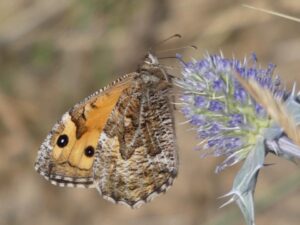
Grayling butterfly
The grayling butterfly is the UK’s largest brown butterfly and can be found in both coastal and heathland habitats. It uses the patches of open sand of sand dunes to sunbath with its wings closed and can often be seen lying on its side.
One of its primary food plants as an adult is Sea-holly Eryngium maritimum.
Fun Fact!
There are six subspecies of grayling occurring in the UK, including one found on the Great Orme in North Wales where they are smaller than normal.
Dave Costello
Plants
- Isle of Man cabbage Coincya monensis ssp. monensis
- Horsetail Equisetum x meridionale
- Rock sea lavender Limonium britannicum ssp. celticum
- Sea club-rush Bolboschoenus maritimus
- Sea cabbage Crambe maritima
- Marram grass Ammophila arenaria
- Early marsh orchid Dactylorhiza incarnata
- Northern marsh orchid Dactylorhiza purpurella
- Sedges Cyperaceae spp.


