
Correction from June’s Newsletter
Hello everyone,
Before we get into all the exciting content the July newsletter contains, I would like to make a correction from June’s newsletter.
In the article about our work with Chester Zoo planting Sea-Holly at Red Rocks Nature Reserve, I stated that Sea-Holly was a member of the Thistle family. This is incorrect, and it is in fact a member of the Carrot family (Apiaceae), and its Latin name is Eryngium maritimum.
Apologies,
Emily

TIME AND TIDE – IT’S A BORE AT CHESTER HERITAGE FESTIVAL
On the 19th June, our Communications and Campaigns Officer Emily attended a Chester Heritage Festival talk on the Dee bore wave. The talk, delivered by Paul Hyde and hosted by Blacon Library as part of the Chester Heritage Festival, was a fascinating insight into how bore waves are created and when is the best time to see them.
We have posted information about the bore wave on our social media channels in the past and we will continue to try and keep you updated on when you can next expect to see the bore wave so keep an eye on our social media channels but if you don’t use social media here is a list of dates for the remainder of 2023. These dates are when high tide is above 9.5 meters in Liverpool which means there is a good chance of the bore wave being visible between Saltney and Queensferry. However, there is no guarantee as there are many other variables that effect the bore wave such as barometric pressure, water levels in the river and overall weather conditions.
Potential bore wave events:
August: 2nd, 3rd, 4th, 5th, 6th, 29th, 30th and 31st
September: 1st, 2nd, 3rd, 4th, 27th, 28th, 29th and 30th
October: 1st, 2nd, 3rd, 26th, 27th, 28th, 29th, 30th and 31st
If you are a bore wave enthusiast or you spend a lot of time on the coast of the Dee Estuary, then we recommend investing in a copy of the tide table. This can be purchased from a number of locations in the area including RSPB Burton Mere Wetlands. Or if you’d prefer to access them digitally the Dee Estuary Birding website has a great list of resources.
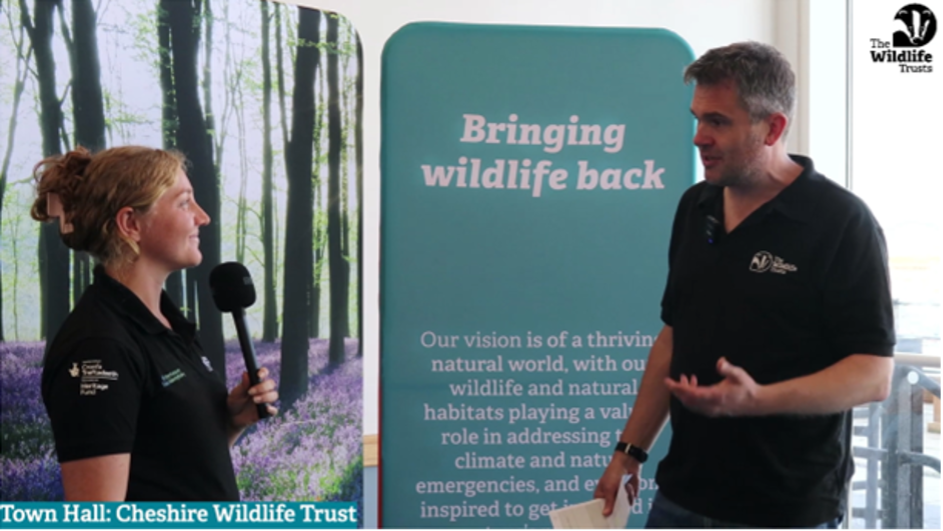
ROYAL SOCIETY OF WILDLIFE TRUSTS TOWN HALL
Last month Cheshire Wildlife Trust and Our Dee Estuary were selected to host the Royal Society of Wildlife Trusts (RSWT) Town Hall. This event takes place every three months and is an opportunity to highlight and celebrate the work of individual trusts amongst their peers.
The June event was focussed on all things marine and we were pleased to be joined by our neighbours and partners from the North Wales Wildlife Trust and Cumbria Wildlife Trust. We spent a windy but gorgeous day at Red Rocks nature reserve creating a film to showcase the site, and its special habitats and species. We were joined by partners from the Butterfly Conservation Society, and one of own dedicated citizen science volunteers, Susanne, to talk about their work and share their experiences with us. We are grateful to all involved in making this happen.
These opportunities are vital for us to be able to demonstrate how partnership projects, such as Our Dee Estuary, can bring people and organisations together to have a larger and more lasting impact on the natural world and our own communities.
As a group of wildlife trusts we operate independently but we are all working towards the same set of goals. Finding more ways to work together is something that we are striving towards. The North Wales Wildlife Trust are official partners of the Our Dee Estuary project and support us in our delivery of events, volunteering opportunities, and improved access to nature on the Welsh side of the estuary.
The Cumbria Wildlife Trust take the lead on the Living Seas North West group which includes Cheshire and Lancashire Wildlife Trusts. Through this we work together to influence decisions around how the marine environment is managed, monitored, and protected. For more information take a look at their website.

WILDLIFE EXCHANGE SESSION WITH RECORD & CHESTER ZOO
On the 31st of May our Communciations and Campaigns Officer, Emily, delivered an online talk as part of the Wildlife Exchange talks series run by rECOrd and Chester Zoo.
If you would like to watch the talk it is now available to view online via rECOrds YouTube Channel.

CITIZEN SCIENCE UPDATE
A team of citizen scientist volunteers have been supporting a region-wide effort to investigate the quality of the water in local rivers, streams and outfalls that flow into the Dee Estuary.
The map below, from The Welsh Dee Trust, shows where volunteers have sampled the water with orange markers showing samples that indicate water quality is a concern.
We will review results after 6 months of data has been collected, in a variety of weather conditions to determine:
- Streams of highest concern, and flag concerns to statutory authorities.
- Streams of concern where further investigation and ongoing monitoring is required
- Streams of good quality with a low level of concern.
If further investigation is required, we may work with volunteers to undertake a wider range of tests or work upstream to try to identify the source of an issue.
Where initial tests indicate water quality is good, we will confirm this by looking at the insects that live in the stream. After all, the presence or absence of life is the best indicator of the health of an ecosystem.
We currently have a gap in data along the Flintshire coastline, so we’re planning further training there during August. If you’re in that area and have concern about the water in your local streams, please contact Matt using the link below.


HISTORY AND NATURAL HERITAGE OF THE DEE ESTUARY
Emily, our Communications and Campaigns Officer, is getting more and more interesting information coming in from her History and Natural Heritage volunteers.
Check out some of the highlights below. We will also be sharing content on social media so follow us for more history and heritage!
Dorothy Griffiths
In 1655 the village of Picton, about 6km south of Point of Ayr was the centre of an allegation of witchcraft which might have resulted in an execution of an innocent woman but for the intervention of the local community who spoke out in her support.
The allegation was made by one William Griffith against Dorothy Griffith, no relation. He stumbled into an alehouse in Picton claiming that while he was travelling to Point of Ayr to re-join his ship, he had witnessed Dorothy on the marshes surrounded by Corpse Lights, believed to be signs of impending death, and that she had vanished suddenly.
The case went to trial but 31 prominent local figures signed a petition attesting to her good character and Dorothy was found not guilty. Closer scrutiny of the evidence against her suggests that this may have been a malicious accusation fuelled by a feud between the two Griffith families.
Allegations of witchcraft were taken very seriously along the Estuary in those days and Dorothy would not have been the first or the last victim of fears and beliefs in the existence of witches.
Halkyn Churchyard
To most people the heritage of Halkyn Mountain and the surrounding area lies in its mining tradition. The signs of mining activity are easy to see with conically capped mineshafts and lime kilns scattered over the mountainside.
However a possibly more interesting feature of Halkyn is the Old Churchyard. The current church of St Marys was built about 1880. About 100 yards away is found the site of the old church and the graveyard surrounding it.
The old church which dated from 1745, although there is evidence that there had been earlier churches since the Domesday Book, was demolished either because it had become too small for the village following expansion due to increased mining, or because the Duke of Westminster thought it spoiled the view from Halkyn Castle, depending on who you believe.
In any event, the churchyard contains a platform where the old church stood and well preserved gravestones that date no later than 1870. There is also a Holy Well and at one time there was a Churchyard Cross which must have been destroyed during the demolition. The headstone of the Cross was found being used as a footrest by the bell ringers of the new church and has since been incorporated into one of its buttresses.
It is not surprising that the Old Churchyard is said to be haunted but whatever you feel about ghosts, a wander around the graves is reported to be a refreshing experience amid a peaceful atmosphere.
Photo Credits: Paul Hyde, RSWT, rECOrd, Bald Hiker – Paul Steele, The Welsh Dee Trust, Terry Daltrey, Flintshire Countryside and Coast, Matt Berry


