

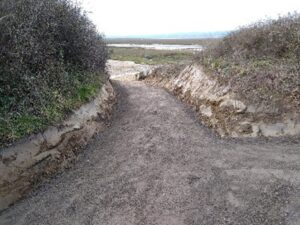
Heswall Beach Path
The Our Dee Estuary project has recently facilitated and funded improved access to Heswall Beach on the Wirral. We worked with our partners at Wirral Council to widen and improve the quality of the path down to the estuary.
This project has been jointly funded by our National Lottery Heritage Funding with thanks to National Lottery players alongside funding from National Trust and Wirral Council.
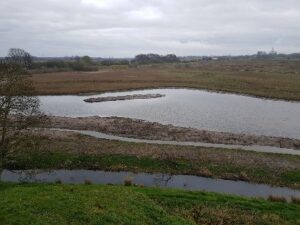
New scrape at RSPB Burton Mere Wetlands
Our partners at the Environment Agency and RSPB Burton Mere have jointly funded a new scrape for wading birds at RSPB Burton Mere.
What is a scrape you might ask? It’s an area where vegetation and soil have been removed to allow water to pool and in this case it’s for wading birds.

Wellbeing with Nature events
We have completed our first round of wellbeing with nature events and we would just like to thank everyone who came along.
These events were jointly funded by SeaChangers, National Lottery Heritage Fund and Sport England’s Go Wild Get Fit initiative.

WELLBEING WITH NATURE AT RED ROCKS NATURE RESERVE
In early March 6 intrepid participants met us for tea and biscuits at the fabulous St Lukes and from there we went to the vast open beach at one of the lowest tides of the year to begin the days wellbeing activities.
A grounding led by Emily invited us all to stop and enjoy the fabulous sounds and sensations, including a lone skylark warbling in the still air over the dunes.
We then grounded ourselves in the long history of the estuary from its sedimentary red sandstone, shaped by successive ice ages, colonised by diverse flora and fauna each adapted to particular niches of this ever-changing landscape, through to the modern pressures on the ecology of the estuary, and the role of key sites like Red Rocks Nature Reserve as a refuge for all life in our increasingly squeezed environment.
Our keen-eyed participants then helped us survey and map scrubby plants invading and disrupting the dynamic dunes.
After lunch we returned to Red Rocks to the reed-beds, where we recreated some of the historic reedbed management by scything breaks through the reeds. It was a full day of learning, observation, connection, compassion, generosity, mud and sweat, and certainly the most active of our wellbeing sessions.
Thank you all for your company and efforts!

GRAYLING LARVAL SURVEYS
We are into week 3 of Grayling larval surveys! Intrepid volunteers are out every week from mid-March to mid-May searching the sand dunes around Red Rocks near Hoylake for these elusive critters.
Why do this? Grayling are the UKs largest brown butterfly and a good indicator of the health of our sand dune habitats. Locally, their numbers have been declining rapidly so this research is essential to understanding their numbers, their behaviour, the food they need and the habitats they live in.
What do they look like? At this time of year, we’re looking for a small, brown, striped caterpillar, approx. 1-2 cm in length. The larvae are nocturnal, so our surveys start at dusk and typically last for 2 hours into the night. We use strong torches to hunt through the vegetation on the sand dunes. Grayling caterpillars typically only eat the tips of very fine grasses, but if disturbed by lights or vibrations will drop off into the dense vegetation of a grassy clump. Also, a sighting can only really be confirmed with photographic evidence.
So, we’re hunting in the dark to photograph a tiny, camouflaged caterpillar that will drop off and hide given the slightest disturbance. Oh, and there are lots of imposter species who look a lot like Grayling caterpillars, but which have slightly different behaviour, or lack the Grayling’s characteristic tapering.
Sounds a bit crazy? Well, maybe… But it is oddly compelling, perhaps even meditative, and the buzz is enormous when someone in the team finds a likely suspect.
To find out more or to get involved check out the Citizen Science volunteer advert.
Photo Credits: Matthew Chapman. Emily Lake, Paul Steele and Dave Costello


