
August 2022

THURSTASTON BEACH
Surrounded by Wirral Country Park, Thurstaston Beach is a popular landmark on the Wirral coastline. It is dominated by red cliffs which reveal sediments deposited when the Dee Estuary was formed during the last Ice Age. As the glacier carved its way through the land it deposited layers of sediment, called till, containing a wide range of rocks gathered along the way. You can see these layers for yourself but don’t get too close as the cliffs are unstable. Recently, we joined Jim Marshall from the Wirral Geology and Landscape Project for a walk along Thurstaston Beach to learn more about the geological history of the Dee Estuary.

MEET THE GRAYLING
The grayling butterfly (Hipparchia semele) is our largest brown butterfly, known for its incredible cryptic colouring. They bask on patches of bare ground with their wings closed and angled towards the sun. Graylings on the ground typically drop their forewing behind their hindwing, and disappear into the backdrop of sand, almost invisible. They’re so well camouflaged that watching one land is no guarantee you’ll find it again!
Graylings can be found basking on sand dunes at the tips of the Dee Estuary, at Talacre and Red Rocks, and nectaring on sea holly. Adults are on the wing from July into September, the best way to see one is to walk along well worn paths and (accidently) disturb it!
Unfortunately graylings are a declining species that have recently been reclassified as endangered in the UK by Butterfly Conservation. We’re working with Dave Costello from Butterfly Conservation to monitor and protect populations along the estuary.
For the past two months, our citizen science volunteers have been involved in surveying graylings along the estuary’s coastline. Their knowledge and butterfly ID skills have really developed during this time, helped by the four training sessions we delivered in partnership with Dave Costello from Butterfly Conservation and his team.
Thanks to our volunteers we’re learning more about graylings. We can use this knowledge to help inform land management decisions, and hopefully secure this secretive butterfly’s future on the estuary.

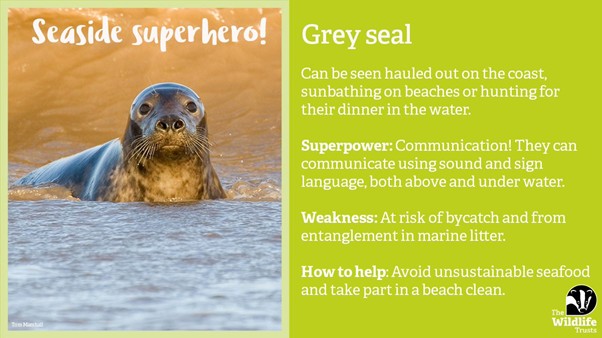
@ourdeeestuary & #NationalMarineWeek
Our Dee Estuary recently celebrated National Marine Week on our social media channels. This celebration of all things marine is a Wildlife Trust initiative and is celebrated across 15 days every year during July. The ‘week’ is 15 days long so that everyone across the UK can celebrate National Marine Week when it is safe to do so due to fluctuating tides. This year we celebrated our oceans’ superheroes, creatures that inhabit our seas and have incredible abilities. If you missed any of the posts you can find them on our Facebook page, our Twitter thread, and our Instagram feed.
Photo Credits: Emily Lake, Charley Dutton.


