
Our Dee Estuary Day of Celebration
The Our Dee Estuary project is coming to an end in March 2025. We will be celebrating all things Dee Estuary at the Hoole Community Centre on the 8th of March. It will be a great opportunity for anyone to attend and find out what we’ve achieved over the last three years, to network with partner organisations and to celebrate everyone’s achievements. Come and party with us!
Our Dee Estuary: A pioneer
The Dee Estuary, a 14,000 hectare area; home to over 120,000 waders and waterfowl as well as a variety of coastal habitats and a dedicated community, has been our project area for the last three years, giving us some big headlines to feature in this newsletter.
The area straddling two countries has been a pioneering project, bringing partners together across borders, using a hands-on approach to delivering lasting impacts by community conservation.
Our Dee Estuary has been largely funded by the National Lottery Heritage Fund with contributions from local authorities, charities, statutory bodies and renewable energy companies. Aside from the financial funding, it can’t go without saying we couldn’t have achieved what we have without the 130 volunteers who have given up over 4,000 hours of their time to practical conservation works, surveying, events, research and writing, we can’t thank them enough.

Improved habitats along the Dee Estuary
Our Dee Estuary has aimed to restore, create and improve habitat, allowing more spaces for nature around the estuary. We have taken targeted action for important species such as Natterjack Toads and Grayling Butterflies and have brought together experts and partners across both sides of the estuary working with these species.
Collaborative working has not only improved the long term conservation goal of specialist habitats and species but also improved the network of volunteers involved in these groups. The work that has been carried out, and the direct improvement of 15.2h of estuarine habitat couldn’t have been done without partner cooperation and the large number of volunteers involved. Some of our highlights include:

- Sand dune management sessions from Presthaven Sands and Talacre down to Red Rocks in Hoylake. This management has included sand patching, dead hedging to block and create footpaths, scything, invasive plant removal and trimming.
- Huge sea holly planting efforts at Red Rocks with volunteers. The plants were propagated by Chester Zoo.
- Natterjack toad pond management across multiple sites at Gronant, Talacre, Bettisfield and Red Rocks. The management has included scraping out ponds of weeds and reeds keeping them clear for toads.
- Wildlife surveys: Butterflies and Natterjack toads. There has been the creation of butterfly transects at Talacre sand dunes as well as regularly walked transects at Red Rocks. There are many more transects in the project area surveyed by dedicated individuals and Friends of Groups. This data is recorded and fed into a national database. Natterjack toad surveys take place during breeding season including spawn string surveys at dedicated pools.
- Reedbed management at Neston reedbed and Parkgate by RSPB Dee Estuary, funded by Our Dee Estuary.
We hope that these improved habitats along the estuary benefits the area and the species that call this place home well into the future.
Bringing together communities
People have volunteered their time, developed skills and become proud of the Dee Estuary’s global significance. The project has raised awareness of the Dee Estuary’s importance for wildlife and enabled a wide range of people to take actions to protect it in a variety of ways. Over the course of the project, Our Dee Estuary has aimed to create a safe and inclusive space which has delivered events to over 2,500 people with communications reaching more than 160,000 people.

There have been interpretation signs installed on both sides of the estuary which explain the natural heritage of the surrounding area. There has also been the development of a website where people can find information relevant to the Dee Estuary in one place, in either Welsh or English.
Our Dee Estuary has provided opportunities in all kinds of areas, not just practical conservation. Some of the opportunities have included sound recording, guided walks, dog friendly events, litter picks, strandline searches, talks and presentations, wellbeing and yoga sessions.
They have enabled communities to create their own sense of place and their own individual connection to the estuary. Those that became involved with the project stated that they benefitted from opportunities such as:
- Meeting new people
- Noticing nature
- Learning more about the natural environment on their doorstep
- Making an ‘appointment’ to be active on the coastline
- Giving their time to citizen science
One Estuary: moving forwards
The Dee Estuary is one of the largest coastal wetlands in the UK. It’s a place of beauty, solace, purpose and some questionable weather. Although the project is at its end, it has definitely had a lasting impact on cross border working and collaboration.
Our Dee Estuary has broken boundaries. The project has encouraged further collaborative working from partners who are all striving to achieve the same thing in the areas they work in – a long term sustainable goal of conservation of the estuarine environment and the recreation, work and heritage this provides our local communities. After all, the Dee Estuary operates as one entity, the ebb and flow of the tides coming and going every day, never knowing that there’s a border down the middle of it.
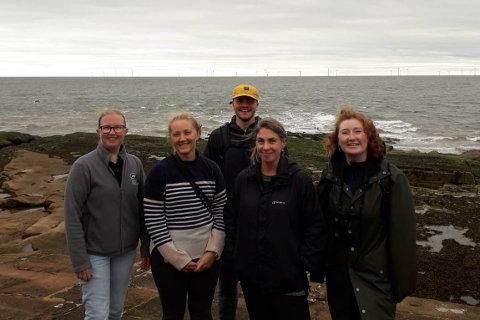
We hope that through the project we have given some amazing groups in the area, doing really good things, a bigger voice to shout about what they do. Despite the project finishing, all of the groups we have worked with from local authority volunteering groups to Friends of Groups are all still running. Keep an eye on our social media pages in the coming months to find out about more opportunities.
The staff at Our Dee Estuary can’t thank everyone who has been involved, no matter how big or small, enough for all of the input you have had. The project really wouldn’t have achieved so much without the help and support of those of you who have taken action and read this newsletter each and every month.
Photo Credits: Our Dee Estuary, David Tipling / 2020VISION, Paul Steele / Bald Hiker.


